On August 27, XPeng announced the first major upgrade to its second-generation VLA. The theme is time. As the designer and productization lead for the Infini-VLA architecture behind this upgrade, I want to use this post to explain what we changed, why we changed it, and how it differs from what the rest of the industry is doing.
Language: 中文
1. Temporal context is the first wall a VLA hits after shipping
After we rolled out the second-generation VLA in March, we kept seeing the same class of issues in real-world driving data: the route oscillating left-and-right before an intersection, hesitation followed by a hard push through a yellow light, “forgetting” a yield commitment made a few seconds earlier during multi-turn intersection negotiation.
On the surface these look unrelated. At the root, they are the same problem: the model has no stable intent and no long-horizon memory. The previous version’s visual input was only a handful of sparsely sampled historical frames — the model’s memory of the world was a single instant. A human driver keeps the last few dozen seconds in their head; a single instant cannot sustain coherent intent.
There was a second problem pushing in the opposite direction: the transient response was not fast enough. Estimating a pedestrian’s acceleration requires a long enough window of continuous observation plus inference latency; sparse sampling caps the floor of how fast the model can react.
Remember for longer, react faster, and the on-vehicle compute budget is fixed. The two demands look contradictory.
Is there an architecture that can solve both without adding compute on the car? Our answer is Infini-VLA.
2. Infini-VLA: treat the driving video stream as one never-ending long document
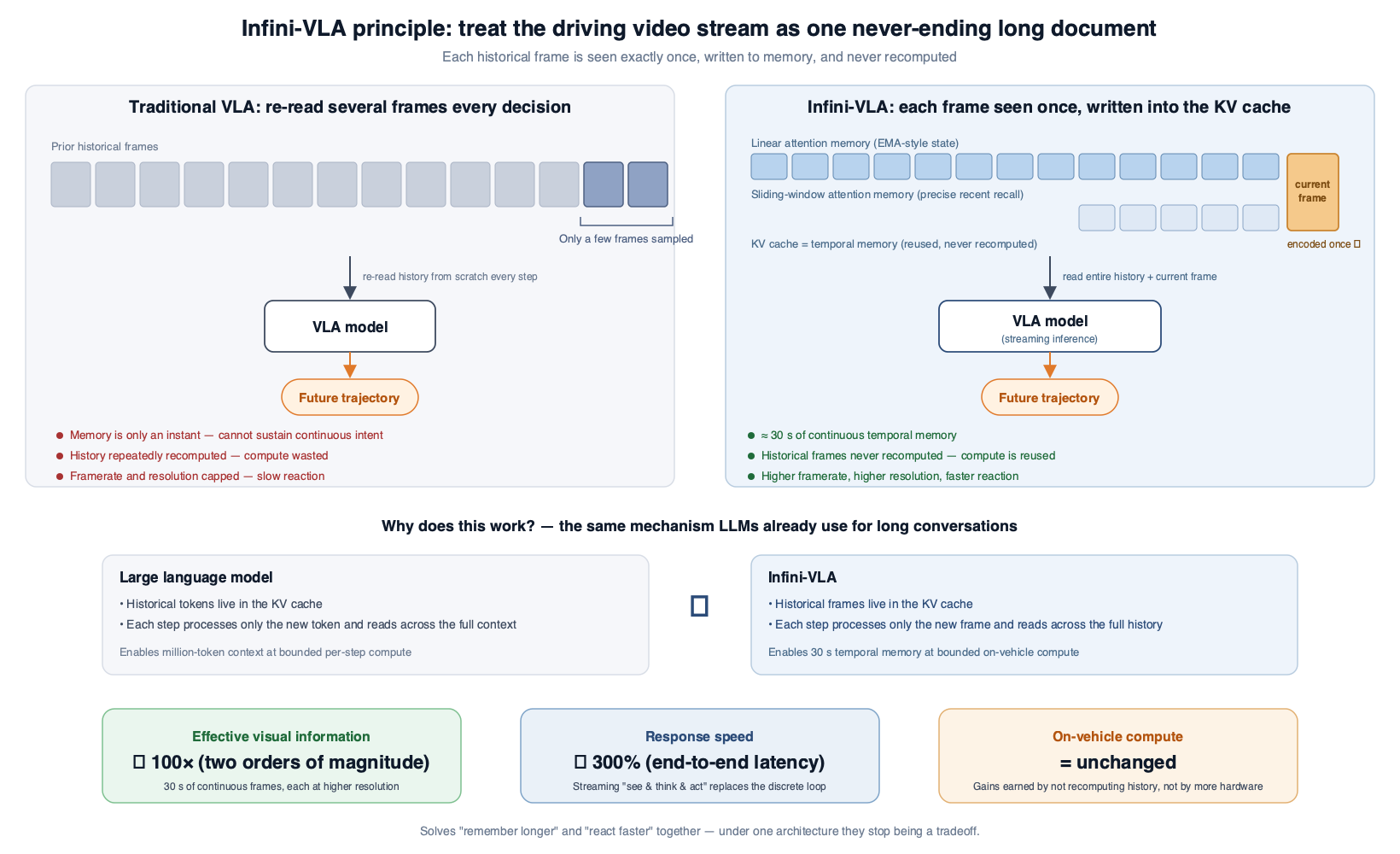
The core idea in one sentence: use the LLM’s KV cache as temporal memory, and use LLM-style long-sequence training plus autoregressive streaming inference for deployment.
When an LLM handles a long conversation, it doesn’t recompute the entire history for every new token — the history already lives in the KV cache. Each step processes only the new token and then reads across the whole cache. This is the foundation that lets LLMs scale to million-token contexts.
An autonomous driving video stream is, in essence, a sequence that never ends. As each frame comes in, it gets encoded into the KV cache and becomes “history”; the decision at the current frame only needs to process the current frame and then read across the entire history. Computation on historical frames is fully reused.
This gives us three direct consequences:
- Memory got longer. Effective temporal memory improved by two orders of magnitude — the actions, positions, and scene from the last 30 seconds now live in the model’s memory.
- Reaction got faster. Because history is no longer recomputed, the freed-up compute is spent ingesting continuous frames and looking at the current frame at higher resolution. The model moves from a discrete “see → compute → output → see again” mode to a streaming “see, think, act at the same time” mode; end-to-end response latency improves by 300%.
- Effective image tokens increased by two orders of magnitude. The previous version saw only a few sparse historical frames per decision; now it sees 30 seconds of continuous frames, each at finer resolution. Effective visual information reaching the model is 100× larger, while per-step on-vehicle compute is unchanged.
To the best of my knowledge, this is the first time in a production autonomous driving model that ultra-long temporal training and deployment have been realized through the LLM KV cache mechanism.
3. Why we call it “Infini”
The name has two layers.
The first is technical. Infini-VLA’s backbone uses hybrid attention: most layers are linear attention, whose memory is a fixed-size state that updates in an exponential-moving-average-like fashion and can in principle carry arbitrarily long history; a few layers are sliding-window softmax attention, which does precise recall over a recent window.
The former remembers “what has been consistently true over the recent past”; the latter remembers “what specifically happened a few seconds ago.” Put together, they map onto the two kinds of memory a human driver relies on.
One more thing that matters a lot: training and inference use the same weights. Training looks like standard supervised learning on long sequences, LLM-style; at deployment the same weights switch to streaming mode. No distillation, no adapter, train-serve consistent by construction.
The second layer of meaning is what we expect from this architecture: it opens up infinite possibilities. Long memory is only the most direct payoff — it triggers a cascade of consequences for training efficiency, scene-specific capability, and cross-version consistency. That leads us to MoT.
4. MoT: separating “memory” from “decision”
The new model introduces an MoT (Mixture-of-Transformers) hybrid architecture. The public framing is “reducing task interference between urban, campus, and parking scenarios.” Let me add a layer from the Infini-VLA side: MoT is what makes Infini-VLA actually work in engineering.
MoT lets different parts of the model specialize. Combined with Infini-VLA’s streaming design, the whole model splits cleanly into two halves: one half continuously observes the world and encodes what it sees into memory; the other half, at every decision moment, produces an action based on that memory and the current situation. The former carries all the temporal state; the latter carries no cross-frame state at all.
Anyone with a classical stack background will immediately recognize this as the new-architecture version of “perception” and “planning-and-control.”
Traditional stacks could ship different planners for highway and city because perception is shared across all scenes and stateless planners can be swapped in at any time. End-to-end VLA broke this for a while — the model has memory, and hard-swapping the model causes the memory to be inconsistent with the new weights. MoT + Infini-VLA gives that capability back: memory is shared across all scenes and always valid, while the decision half can be swapped per scene the way we used to swap planners.
As a consequence, scene-specific experts, capability consistency across OTAs, and more efficient training-side iteration all fall out of the architecture naturally, rather than being separate patches.
5. X-Foresight: after remembering the past, you still need to predict the future
Infini-VLA solves “remembering the past.” But reliable physical-world intelligence also needs to “predict the future”: the car in front braking suddenly, a pedestrian doubling back, a neighboring car forcing a merge — predicting more possible futures is what lets us pick a better present action.
Shipping alongside Infini-VLA for the first time is the X-Foresight predictive world model, which anticipates the likely behavior of surrounding traffic participants over the next 6 seconds.
What I want to emphasize is its relationship with the VLA: they are not two separate models, they are two output heads on the same physical-world foundation model. The foundation learns an understanding of space and motion; attach an action head and it is a VLA, attach a prediction head and it is a world model. The industry keeps debating “VLA or world model” — our view is there is nothing to debate. They are the same thing.
Put together, the puzzle for this upgrade is complete: Infini-VLA remembers the past, the foundation model understands the present, X-Foresight predicts the future. This is what we mean by moving from “3D spatial understanding” to “4D spatiotemporal understanding.”
6. How this compares to the field
“Adding temporal context to VLA” has been hot for the past year. In video understanding, work like StreamingVLM has validated KV cache + sliding window for infinite video streams, but it does not touch real-time control or on-vehicle constraints. In robotics, work like StreamPI has started using KV cache to give VLAs memory, but the authors themselves point out that the training cost of long horizons is hard to bear. In autonomous driving, some work reuses KV across frames purely for inference speedup (FlashDrive), and some introduces streaming memory (MindVLA-U1). In LLMs, linear-attention hybrid architectures have been shown to scale by e.g. MiniMax-01.
Our differences boil down to four points:
- Done on production vehicles — not a demo or benchmark, but a model running on hundreds of thousands of cars on the road today.
- Same weights for training and inference — streaming inference is a pure deployment-time change; train-serve consistency is a structural guarantee, not an after-the-fact fix.
- Effective image tokens up 100× with no additional compute — earned by not recomputing history, not by pruning or compression.
- Memory and responsiveness improve together — two things that were in tension under the old architecture become two sides of the same thing under Infini-VLA.
7. Closing thoughts
If I had to summarize the design philosophy of Infini-VLA in one sentence: the driving video stream is one never-ending long document — so process it the way LLMs process long documents.
Behind that sentence is a coherent set of choices: linear attention for long-term memory, window attention for short-term precise recall, MoT to decouple memory from decision, and streaming inference to unify training and deployment. None of these choices is novel on its own; put together they form an architecture that can ship in cars, iterate, and scale.
Infini-VLA can currently remember 30 seconds. Architecturally, its memory length is not bounded by the model — it is bounded by the deployment budget we chose. The “infinite possibilities” in “Infini” are only just beginning to be tapped.
One note on the order in which we do things. None of what is described in this post has been published as a paper yet. That is not an oversight — it is a choice: first ship the most advanced technique into production and lead the industry, then go back and write the paper. The final test of whether an architecture holds is not a benchmark number, but hundreds of thousands of cars on the road, tens of millions of kilometers of real-world feedback per day. We would rather let the cars run first and users feel it first, then write up methods validated by the real world and share them with the field. Papers will come — but they should be the summary of shipping, not the prerequisite for it.
The author leads the VLA model team at XPeng. Opinions expressed are personal.